
Photo source by Alinear Indonesia Docs. (Adobe FireFly – Gemini AI)
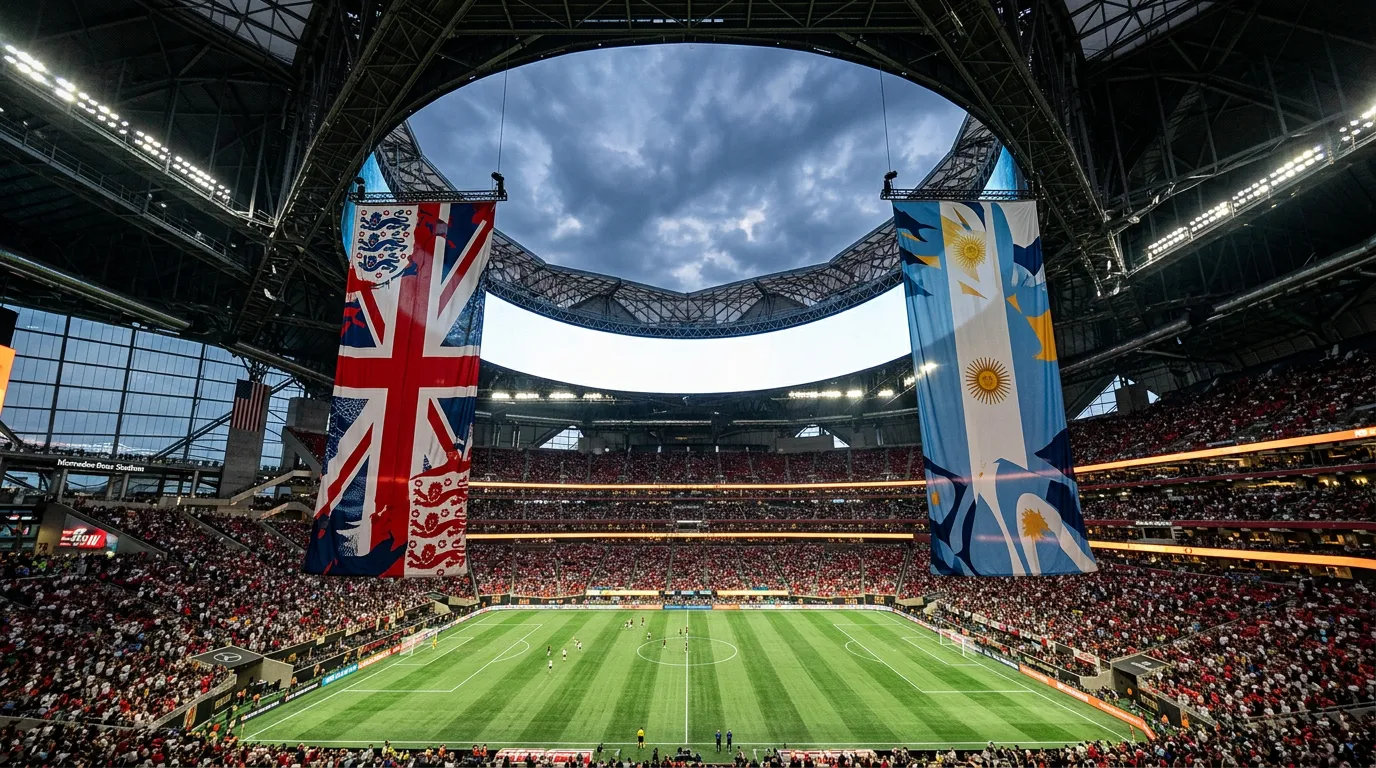
The clash between England and Argentina in the semifinal of the 2026 World Cup is far more than a battle for a ticket to the grand finale in East Rutherford. It is the modernization of one of international football's most storied, emotional, and tactically layered rivalries. Staged inside the architectural marvel of Atlanta's Mercedes-Benz Stadium, this fixture pits two modern footballing empires against each other, each wielding highly contrasting yet equally devastating blueprints.
For England, the appointment of Thomas Tuchel has stripped away ancestral tactical romanticism in favor of cold, tournament-winning stability. Tuchel has engineered a side that is structurally rigid, defensively impenetrable, and lethal on the break. Across the pitch stands the reigning champions, Argentina. Under Lionel Scaloni, La Albiceleste remains deeply committed to collective positional fluidity, rapid short-passing networks, and calculated spatial freedom orchestrated by their eternal maestro, Lionel Messi.
England's Build-Up Mechanics: Tuchel's Positional Rotations
Under Tuchel, England constructs play utilizing a fluid 3-2-5 or 3-4-3 structure in possession. The introduction of a highly disciplined defensive anchor in midfield has liberated Declan Rice to operate in higher left-sided half-spaces, mirroring his dynamic box-to-box role at the club level.

Photo source by Alinear Indonesia Docs. (Adobe FireFly – Gemini AI)
Video source by TVRI Sport HD (YouTube)
By deploying elite, athletic wingers like Bukayo Saka wide on the right and stretching the pitch with vertical runs on the left, England forces the opponent's defensive line to widen. This systemic stretching is deliberately designed to open vertical passing lanes in the center, allowing Jude Bellingham to make late, untracked runs directly into the penalty box.
Midfield Containment: Argentina’s Three-Phase Filter
Scaloni is acutely aware of England’s vertical central threats. Consequently, Argentina’s midfield engine room—typically marshaled by Rodrigo De Paul, Alexis Mac Allister, and Enzo Fernandez—acts as a highly aggressive containment shield before any ball can penetrate the space managed by Cristian Romero.
Video source by PapaBola (YouTube)
Argentina's defensive strategy does not rely on passive zonal containment. Instead, they trigger an immediate, high-intensity counter-press the second possession is lost. The objective of this midfield trigger is to disrupt England’s transitional speed before Saka or Bellingham can turn to face the backline.
Striker Dynamics: Drawing Out the Central Anchors
Harry Kane remains the vital pivot in England's attacking sequence. Unlike previous eras where Kane dropped excessively deep into congested midfield zones out of sheer necessity, Tuchel’s system keeps his movements highly focused on manipulation: specifically, dragging Argentina's center-backs (Cristian Romero or Lisandro Martinez) out of their defensive line.

Photo source by Alinear Indonesia Docs. (Adobe FireFly – Gemini AI)
Video source by FolaPlay (YouTube)
"Thomas Tuchel does not design football teams to entertain the masses; he engineers them to choke structural space with mechanical precision."
As Kane drops a few yards to receive and hold the ball, the physical space vacated by the advancing Argentine defender is instantly targeted by diagonal inside runs from wide forwards or vertical overlapping runs from Bellingham. It is an intricate game of tug-of-war that demands flawless communication from the South American backline.
Strategic Outlook: The Micro-Margins of Success
At this elite level, semifinal encounters are almost exclusively decided by the smallest tactical margins: structural rest-defense efficiency during fast transitions and set-piece execution. England possesses a distinct physical advantage in aerial duels, while Argentina holds the edge in individual improvisational brilliance in tight spaces.
This match is poised to be an exhausting, high-level tactical chess match. Should England maintain their rigid defensive compactness against the rotating gravity of Messi and Julian Alvarez, their physical superiority and bench depth could exploit a fatigued Argentine transition late in the second half.
Video source by FolaPlay (YouTube)

Photo source by Alinear Indonesia Docs. (Adobe FireFly – Gemini AI)
"When Argentina's fluid poetry of space collides with England's structural prose, footballing beauty is redefined by the friction between freedom and discipline."
WRAP-UP!
The Atlanta semifinal showcases an epic clash between two of modern football's definitive schools of thought. England brings structured efficiency, defensive compactness, and physical power under Thomas Tuchel. Argentina counters with collective tactical chemistry, rhythmic possession, and world-class individual intuition under Lionel Scaloni. Both stand mere steps away from the ultimate stage.
Video source by TVRI Sport HD (YouTube)
England's tactical department must successfully isolate Enzo Fernandez's distribution lanes to starve Lionel Messi of early service in the final third. Conversely, Argentina's staff must execute a zonal blocking scheme on set-pieces to neutralize England's substantial height advantage in the box.
Looking to feature your brand and business through Alinear Indonesia’s Smart Publication & Smart Activation? Share your experience and consult with us today. Click here!
![Smart Publication+ 3.0: Build Authority. Drive Growth. [Technical Specification]](https://www.alinear.sr-digital.biz/assets_web/images/qr-codes/bd48cb0acb2d9586570edb8a7303cee1.jpg)