



Photo source by Alinear Indonesia Docs. (Adobe FireFly – Gemini AI)
Traditional business models have long relied on a flawed performance metric: measuring a professional's productivity by their visibility or their readiness to respond to messages instantly across a full eight-hour shift. This always-on paradigm has created a culture of chronic interruption. Unscheduled alignment calls and fragmented updates scattered throughout the day break cognitive focus, forcing the workforce into a shallow, reactive mode that drains mental energy and limits long-term output.
This efficiency crisis demands a complete structural overhaul of corporate communication design. Organizations are discovering that keeping a team in a constant state of hyper-responsiveness does not produce better results; instead, it accelerates burnout and lowers the quality of strategic execution. Addressing this management challenge requires a deliberate redesign of the operational environment, drawing a clear line between when a team must align and when they must produce: The Core-Hours Collaboration Model.
The operational engine of the Core-Hours model relies on deconstructing the workday into two functional zones: the Synchronous Collaboration Window and the Asynchronous Autonomy Window. The system strictly restricts mandatory real-time availability to just three consistent hours per day—for example, from 1:00 PM to 4:00 PM.
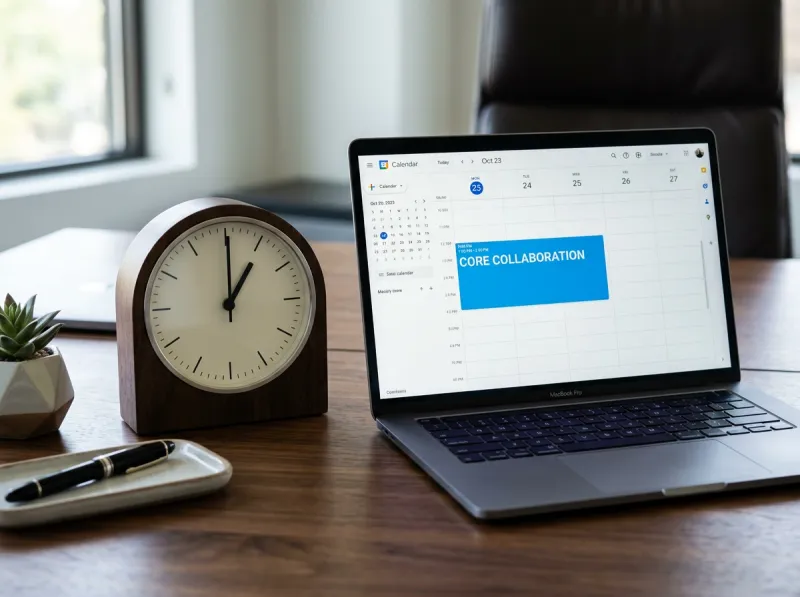
Photo source by Alinear Indonesia Docs. (Adobe FireFly – Gemini AI)
Outside of this three-hour window, control over scheduling returns entirely to the individual. This protocol is highly valuable for organizations maintaining lean operational budgets, whether they are self-funded startups (bootstrapping) that must maximize every working hour without waste, or venture-backed enterprises (venture capital) pushed to hit aggressive scale targets rapidly. Mornings are cleared for deep, uninterrupted work, while late afternoons are reserved for independent execution, creating a sustainable operational balance.
Separating communication windows directly addresses the human brain's need for undisturbed time to enter a state of high productivity (flow state). When a professional can count on a schedule free from unexpected meetings between 9:00 AM and 12:00 PM, they can dedicate their highest cognitive energy to complex, analytical objectives—such as writing clean code, building marketing strategies, or running macroeconomic models.
The psychological impact of owning one's time significantly improves employee job satisfaction. Autonomy over solo execution schedules dramatically lowers organizational stress and increases individual accountability. Performance is no longer judged by how quickly someone replies to a chat notification, but by the quality of the deliverables completed by the end of the sprint cycle, shifting corporate culture away from the theater of presenteeism toward substantive performance.

Photo source by Alinear Indonesia Docs. (Adobe FireFly – Gemini AI)
Restricting real-time alignment to just three hours a day forces an organization to practice strict communication discipline. Meetings can no longer be called without a clear written agenda or allowed to run past their scheduled timeline. Every minute within the core-hours window is treated as a premium asset that must be managed with high efficiency.
Consequently, this model drives the adoption of a strong asynchronous documentation culture. Before any meeting occurs within the core-hours window, organizers must provide a concise brief outlining the context and the key decisions required. Status-update conversations are moved entirely to written threads, ensuring that the three hours of face-to-face time are used exclusively for complex debates, cross-department problem-solving, and final decision-making. This radical approach removes the administrative drift that typically drains organizational energy.
"True productivity is not born from eight hours of continuous surveillance, but from providing a secure space where the mind can execute complex tasks without interruption."
Looking at the future of workplace architecture, implementing a Core-Hours model is no longer just an experiment in employee wellness; it is a defensive business strategy to retain top tier industry talent. Modern professionals prioritize schedule flexibility and operational otonomy on par with financial compensation when evaluating long-term career moves.
Photo source by Alinear Indonesia Docs. (Adobe FireFly – Gemini AI)
For companies operating in highly competitive markets, offering a work system that protects cognitive health and focus is a distinct competitive advantage. The model demonstrates that a business can maintain rapid global coordination and high operational velocity without demanding constant availability from its teams. Through precise time calibration, the boundary between high productivity and personal flexibility is no longer a contradiction, but a balanced operational synergy.
"The Core-Hours model changes meetings from a time-draining corporate ritual into a high-precision tool for tactical decision-making."
WRAP-UP!
The implementation of The Core-Hours Collaboration Model represents an essential shift in modern workplace management architecture. By compressing daily synchronous coordination into a targeted three-hour window and clearing the remaining schedule for undisturbed deep work, businesses successfully eliminate meeting fatigue without losing cross-team alignment. This system balances operational efficiency with employee autonomy, providing a robust cultural framework that serves both lean, bootstrapped operations and heavily funded venture setups navigating competitive global markets.
Audit your organization's internal calendar schedules; analyze the volume of low-impact meetings scattered throughout the day, establish a universal three-hour anchor block across departments, and transition to a core-hours model to optimize your team's cognitive output.
Looking to feature your brand and business through Alinear Indonesia’s Smart Publication & Smart Activation? Share your experience and consult with us today. Click here!



![Alinear Indonesia [Brand/Business Registration] Smart Publication & Smart Activation](https://www.alinear.sr-digital.biz/assets_web/images/qr-codes/3e23e7dab43d2e72854ba48a3a09cf75.jpg)